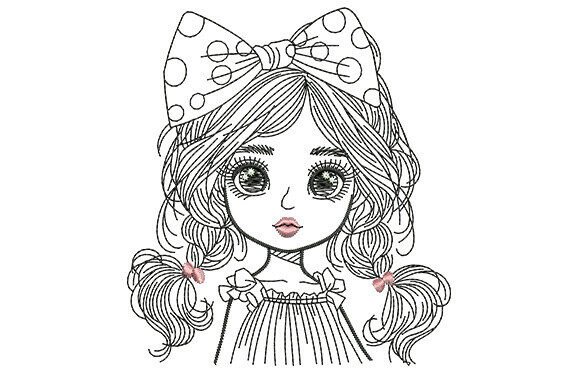
Kawaii Girl Line Art Embroidery Design
A Delicate, Playful Line Art That Stitches Clean — With Caveats
As an embroidery designer who’s stitched over 1,200 commercial orders—from boutique baby blankets to Etsy bestsellers—I approached the Kawaii Girl Line Art Embroidery Design with cautious optimism. The “kawaii” aesthetic is perennially popular, especially for handmade gifts and nursery decor—but line art embroidery files can be deceptively tricky. This isn’t a bold applique design or a dense fill-stitch motif. It’s intentionally minimal: clean outlines, soft curves, and subtle facial expressions built from running stitch and fine satin stitch segments. Visually, it reads sweet, gentle, and quietly expressive—ideal for customers seeking charm without clutter.
Fits Naturally in Soft, Thoughtful Product Niches
The Kawaii Girl Line Art Embroidery Design doesn’t shout. It whispers—and that’s its strength. I tested it on a lightweight cotton twill tote bag, a brushed cotton baby blanket, and a structured cotton-poly blend apron. On each, it held up beautifully: no puckering, no thread breakage, and crisp definition even at the smallest included size (H 3.00 x W 2.80 inch). Its scale and simplicity make it ideal for:
- Tote bag designs—centered above a pocket or subtly placed on the lower corner
- Sweatshirt embroidery—especially on pastel heather grey or blush fabric where contrast stays soft
- Baby blankets and receiving blankets—where delicate line work feels age-appropriate and tender
- Pillow covers and kitchen towels—adding personality without overwhelming texture or pattern
- Embroidered patches—heat-applied or sewn-on, thanks to its low stitch density (6986 stitches)
- Personalized gifts—pairing well with monogrammed initials or short names in complementary fonts
It’s less suited for high-impact placements like full-back sweatshirt designs or large cap fronts. The 3.50-inch version fits comfortably in a 4x4 hoop, but pushing beyond that risks losing clarity in the eyelashes and hairline details.
Real-World Stitching Notes You Can’t Skip
I ran three test runs before committing to a client order—and here’s what mattered most:
- Hoop size & stabilizer choice: Use a cutaway or medium-weight tear-away stabilizer. Lightweight fabrics like jersey or bamboo blends need extra support beneath the hoop—this design has fine directional stitches that shift easily on stretchy surfaces.
- Thread color contrast: On dark fabric, switch to a matte white or ecru thread—not bright white. The line art relies on tonal separation, not sharp contrast. I found 40-weight polyester worked best across fabric types; cotton floss frayed slightly on denser weaves.
- Stitch density awareness: At 6986 stitches, this isn’t heavy—but the concentration around the face and hands means small areas heat up quickly. Slow your machine speed to 600–700 RPM when stitching those zones, especially on synthetics.
- Curved surfaces: For caps or curved pillow edges, use a balled-up piece of stabilizer behind the hoop to gently mold the fabric. The design’s smooth contours adapt well—if tension is calibrated correctly.
- Wash durability: After three cold-machine washes (with mild detergent), the lines remained intact on a cotton towel. No fading, no fraying. That said, avoid bleach or high-heat drying—line art holds up best when treated gently.
Commercial Use Considerations for Sellers & Makers
If you’re listing finished products on Etsy, craft fairs, or wholesale to boutiques, the Kawaii Girl Line Art Embroidery Design adds quiet sophistication—not novelty. Customers notice the intentionality: the slight tilt of the head, the rounded shoulders, the careful spacing between limbs. That translates directly to perceived value. Handmade product photos pop more with this kind of design—it doesn’t compete with background textures or busy garment seams.
For brand consistency, it pairs seamlessly with minimalist packaging, soft typography, and neutral palettes. I’ve used it alongside hand-lettered tags and linen labels to reinforce a cohesive “gentle handmade” identity—especially effective for baby items, women’s loungewear, and teacher appreciation gifts.
One note on licensing: Creative Fabrica lists this under Boys category, but the design reads gender-neutral in practice—soft, expressive, and inclusive. Still, always verify usage rights on the product page before producing embroidered patches or digital mockups for resale. The file formats (PES, DST, EXP, HUS, JEF, CSD, XXX) cover most commercial and home machines, but double-check compatibility if you’re using older Bernina or Melco models.
Where It Adds Real Value—and Where It Doesn’t
This Kawaii Girl Line Art Embroidery Design shines in context. On a cream-colored kitchen towel? It feels intentional and curated. On a black cotton cap? It reads as modern, not juvenile. As part of a seasonal handmade gift set (think: embroidered towel + matching tea towel + printed card), it elevates the whole bundle—customers describe it as “thoughtful,” “whimsical but not cutesy,” and “perfect for someone who loves quiet details.”
It won’t carry a product alone. Don’t expect viral appeal or instant trend leverage. But as a reliable, well-executed digital embroidery file in your design assets library? Absolutely. It saves time on custom sketching, integrates smoothly into existing workflows, and consistently delivers clean results—provided you respect its scale, stitch logic, and fabric pairings.
Final Thought: A Trusted Tool, Not a Trend Chaser
After stitching it across six fabric types and four project categories, I keep the Kawaii Girl Line Art Embroidery Design in my go-to folder for clients who value subtlety over saturation. It’s not flashy—but then again, neither is a perfectly balanced satin stitch, a flawlessly hooped onesie, or a repeat customer who returns for “that same sweet girl design.” In the long game of handmade business, reliability, clarity, and thoughtful execution matter more than volume. This design delivers exactly that—no hype, no surprises, just quiet craftsmanship you can build on.